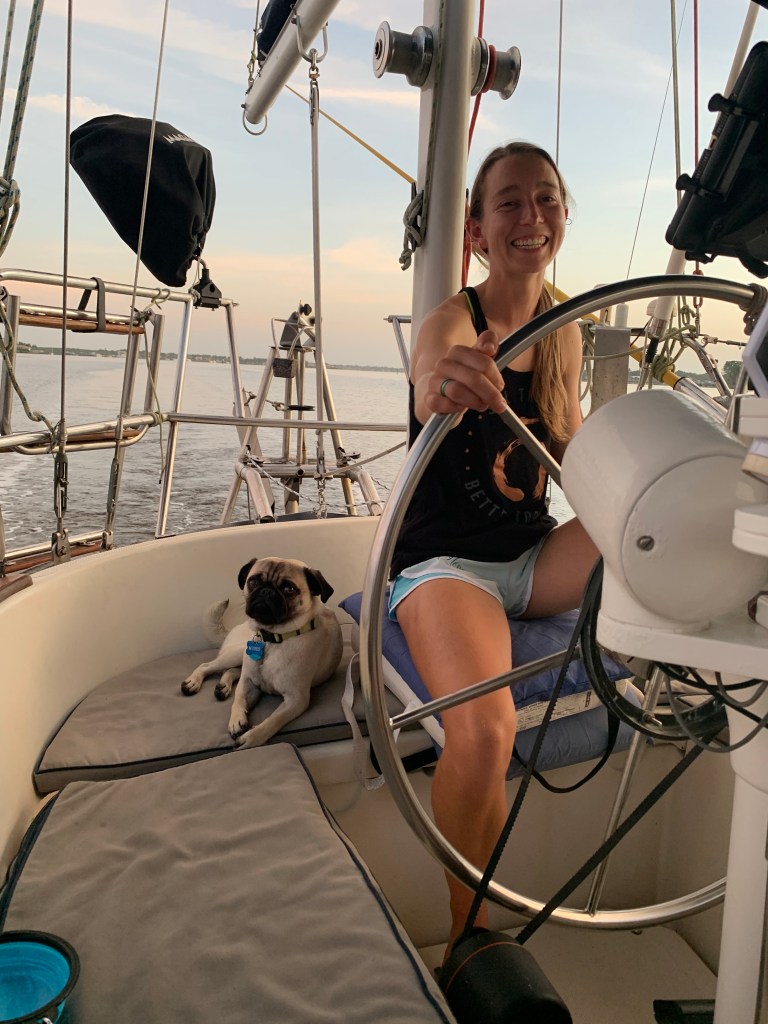
We had gone to bed Saturday night, intending to wake up and start motoring out of the St. Johns river by 0830 to complete a supposedly 3 hour trip IF you had the current with you. Our new friends from Sailing for the Son helped us cast off our dock lines and away we went. While the current was not 100% in our favor, we made it through two lift bridges (Ortega Bridge and Main Street Bridge), avoided some barge traffic, and arrived at Ft. George Island Marina by 1 pm (that’s 1300 for you military folk). We had driven to Ft. George Island Marina the day before to fill up our jerry cans and scope out the marina. The generous T-Head pier was deep enough to accommodate Kismet‘s 5.75 ft draft, and we planned to top off on diesel before heading out to the Atlantic for our possible 5-day trip to Marathon, FL in the Keys.
Oh, how we were disappointed. We arrived to find a large 50 ft cruising yacht docked at Ft. George Island Marina, at the same time having to fight a heavy current from the in-bound tide. So much for tide times and speed calculations. The staff at Ft. George said we could come inside the T-Head since the rather large yacht had no plans to move any time soon. Conveniently, it was only after watching us run aground that the cruising yacht decided to depart the T-Head. I guess there will always be misunderstanding between motor-boaters and sailboaters – or as Jimmy’s grandmom who sailed a custom 40 ft yawl likes to say, “Those stink-pots will never understand us rag-baggers!”
We did fuel up, and the staff even finagled a way to pump up our dinghy since we had forgotten our foot pump. Although we have a life raft aboard, it was last certified in 2010, and we wanted to guarantee a mode of safety should the life raft NOT inflate.
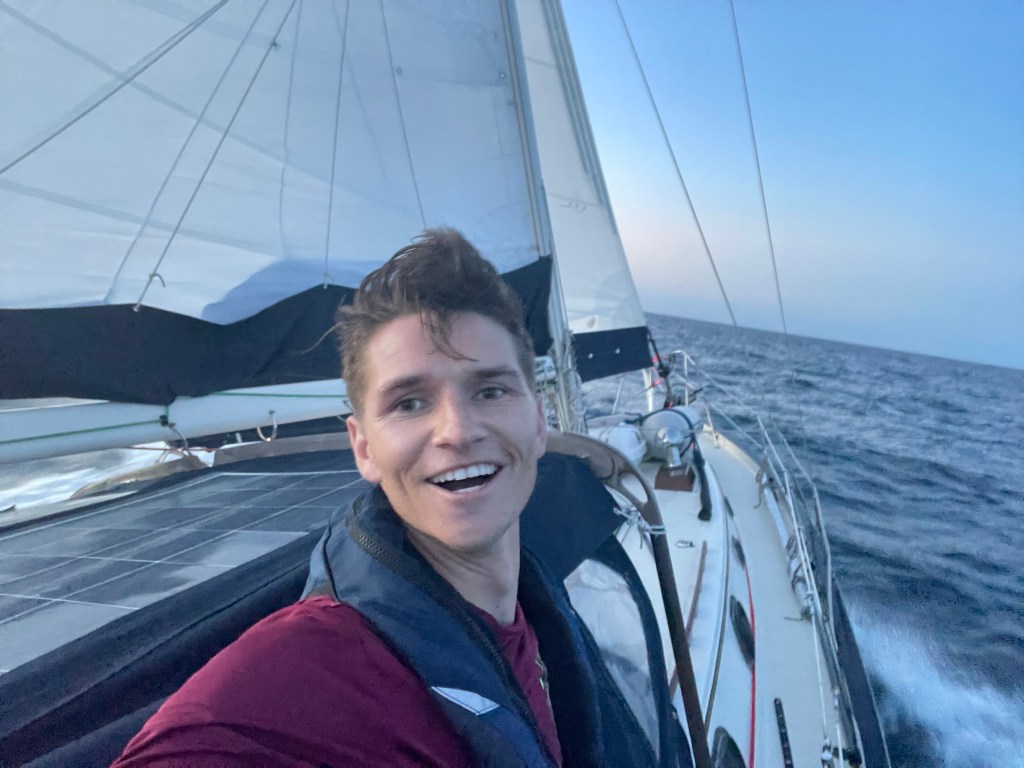
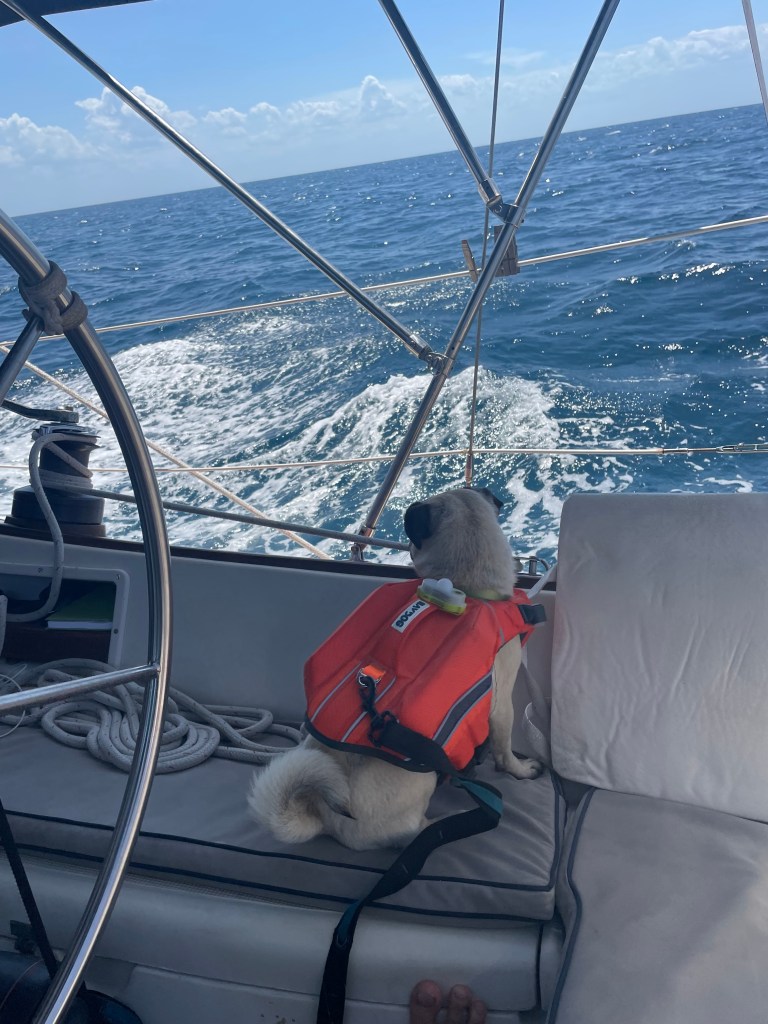
Once out in the Atlantic, the seas were fair – about 3-4 ft – and the wind was coming from the southwest. This allowed us to take a close reach and sometimes beam down the coast a ways. We were feeling good after the first 24 hrs, having made nearly 100 NM! Jimmy was slowly getting over his seasickness and we were falling into a comfortable watch cycle of 4 hrs on – 4 hrs off. Moses, also feeling a bit seasick, was the best snuggle buddy during off-watch naps.
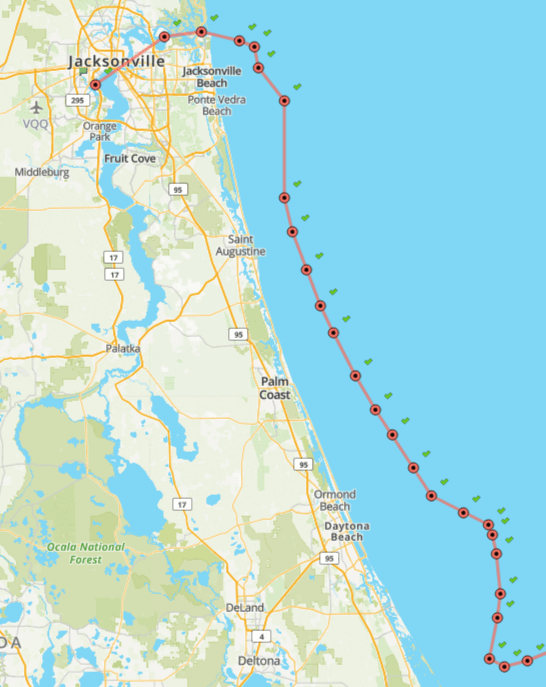
It was late into Sunday night, as we approached Cape Canaveral, that the wind shifted and our progress slowed. The wind now was coming right out of the south to south-southeast. This meant at the best of times, we could point south, but with a lee-shore. For those who are reading this and are unfamiliar with sailing, you cannot sail directly into the wind, even if that is where you want to go. You must sail at an angle off the wind (Kismet happily sails at 60-degrees off the wind) in order to create lift in the sails and speed along. However, the downside of this physics that is sailing means that you have to do diagonals to get to your destination. Sailors call this zig-zagging “tacking” and, boy, did we zig-zag to get around Cape Canaveral!
The trouble was not just the wind direction, but the fact that Cape Canaveral is home to a U.S. Space Force Base, and near the Kennedy Space Center, which means that the area is subject to multiple rocket and satellite launches. The Coast Guard publishes a Local Notice to Mariners to outline restricted areas if there will be a launch, or military exercise, in the area. Cape Canaveral also has lots of shoaling up to 10 NM offshore, which we also wanted to avoid. All that being said, we made only 20 NM in the next 12 hrs.
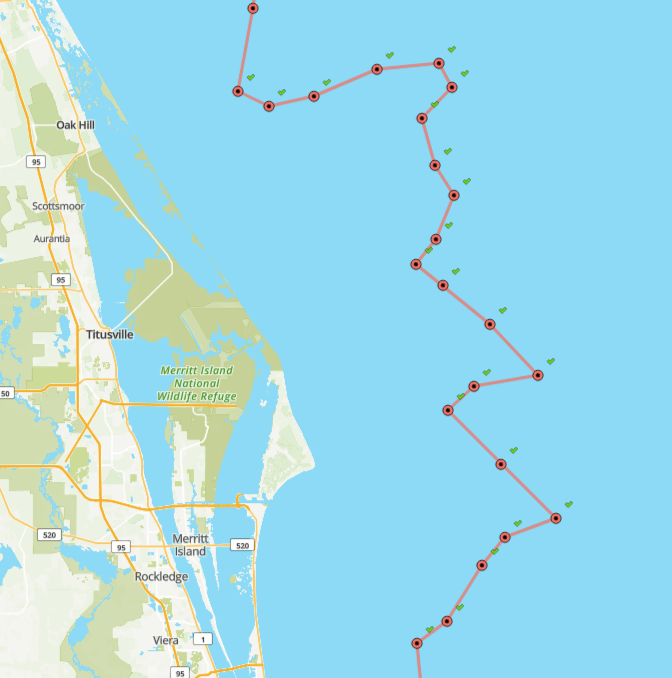
Tuesday morning, we decided to head for Ft. Pierce, the next largest inlet to access the Intracoastal Waterway. We were fed up trying to point directly up-wind with only the mainsail out, and making a slow 3.5-4 knots. As it turns out, our friends from Sailing For the Son came to our aid again providing tips on how to navigate Ft. Pierce inlet at night, and where to anchor. We are really thankful for having met Capt Bill!
Many sailors will tell you to never arrive at an unfamiliar port at night, and generally, that is something us Shipleys live by. But on this occasion, once again because we were sailing on a timeline, we decided to risk it. Thank goodness it is a large inlet, highly recommend if you do have to enter an inlet at night. The decision to enter the ICW meant we were also committing to long days of motoring and stopping at night, which would also slow our progress. We had heard it was possible to cut across Florida through the Okeechobee Waterway (OWW) IF your mast could make it under the Port Mayaca Railway Bridge (vertical clearance: 49 ft). It also meant managing 5 locks (open 7am-4:30pm), multiple swing/lift bridges, and crossing the infamously shallow Lake Okeechobee. Read more about our OWW experience here.
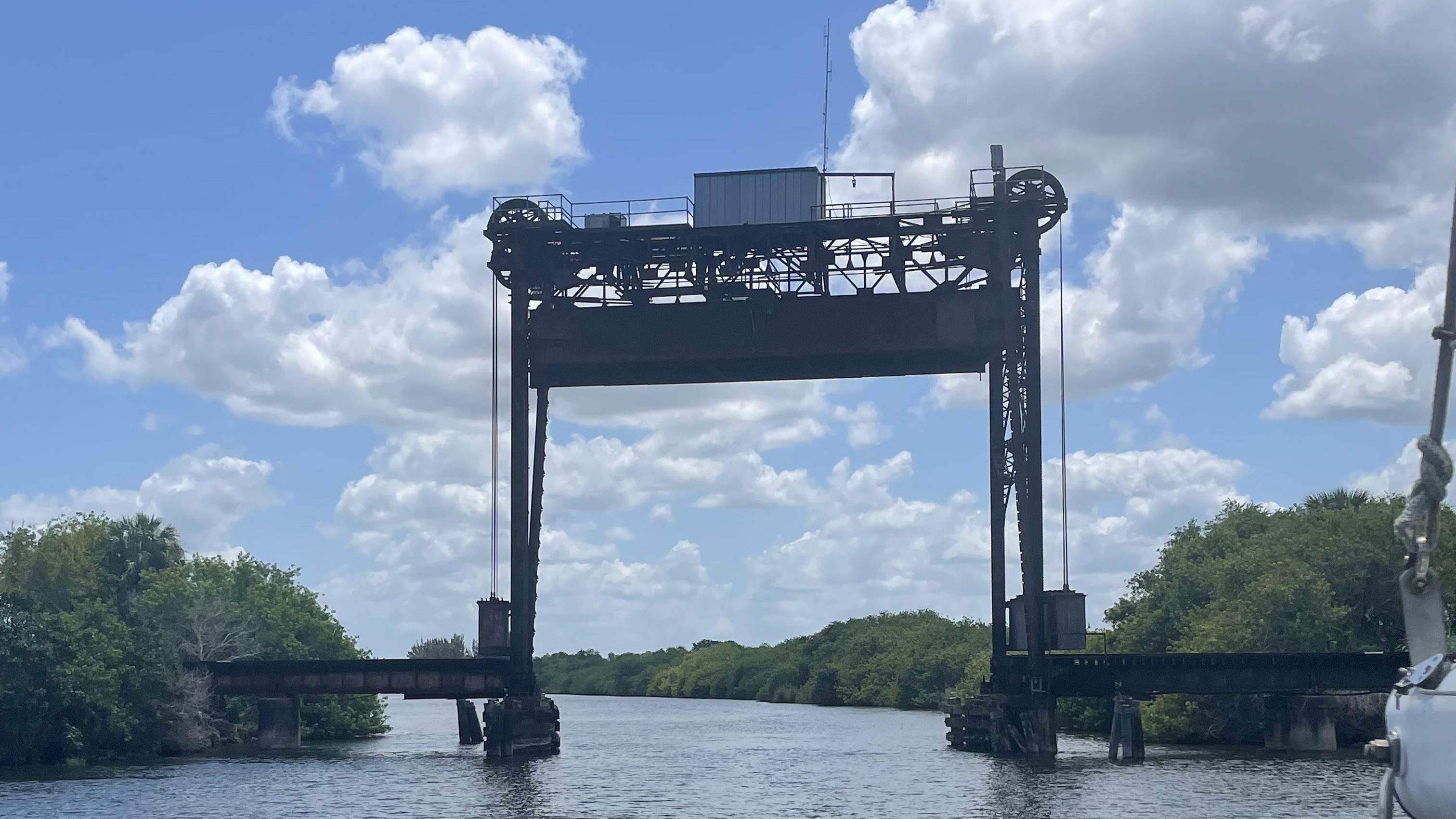
Kismet‘s vertical draft is 47’10”, but we were still nervous about making it under the bridge. It would be completely demoralizing to arrive only to have to turn around. Our experience up the St. Lucie River was harrowing and not one we wanted to repeat. We ran aground at the intersection of the St. Lucie River and ICW (note: the shoals are on the left side of the inlet, not the right!) where center consuls drove past us with reckless abandon, creating so much wake I thought the keel would eventually buckle. Luckily, TowBoat U.S. came to our rescue within 10 minutes – it was obviously a spot MANY before us had run aground. Being the second time in 8 hrs we had run aground, we were thankful for our TowBoat U.S. Gold membership.
Although we missed the last lock at the beginning of the OWW and had to motor an hour back to Stuart, FL with the rudder between our legs, the relationships we had formed in the boat-buying process came through again. Our broker had a boat in Stuart, and knew where could pick up a mooring. To top it all off, she even took us to dinner! Moses was never happier to be back on land after 3-days at sea!
All that being said, our trip through the OWW was mostly uneventful. We made it under the Port Mayaca bridge with a foot to spare, navigated the locks, called upon the bridges, and saw our fair share of alligators, manatees, and even cows! The motoring was hot, but our trusty Universal engine (which may in fact be the original from 1982) chugged along. It was a relief to arrive at Ft. Myers City Yacht Basin, plug into AC power, and run our air conditioner. Not to mention being able to shower, do laundry, and address some minor problems that had arisen during our voyage.
We were happy with our progress and decision to take the OWW. It is a once-in-a-lifetime experience, and one we hope to only do once! But it allowed us to make it up the coast of Florida further than we had originally planned. Being in Ft. Myers meant we had a 3-4 day hop across the Gulf of Mexico before reaching our home-port in Niceville, FL. The end was in sight! Before we could declare an official “Land-ho!” in Niceville, we had to leave the boat in Ft. Myers for 2 weeks while we went back to work. Our day jobs do not allow us much vacation so we were slowly making the trip on long weekends. Until 4th of July weekend, Kismet would sit comfortably on her mooring ball and wait for our return.


 The Sailing Shipleys
Leave a reply to Brian L Fink Cancel reply